
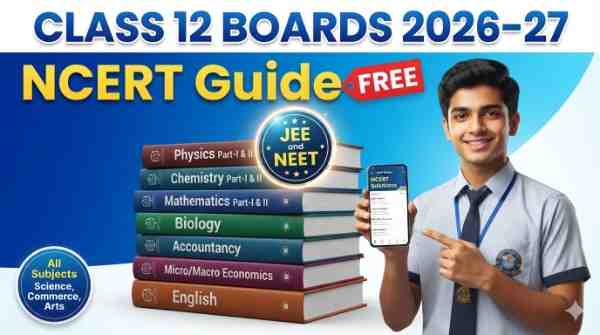
NCERT Solutions for Class 12 All Subjects 2026-27 | Free Chapter-Wise Guide
Want for offline use Download the PDF with all the details :
Table of Contents
- Introduction
- Why NCERT Solutions Are the Most Important Resource for Class 12
- NCERT Solutions Class 12 Physics Chapter Wise
- NCERT Solutions Class 12 Chemistry Chapter Wise
- NCERT Solutions Class 12 Maths Chapter Wise
- NCERT Solutions Class 12 Biology Chapter Wise
- NCERT Solutions Class 12 Commerce – Accountancy and Economics
- NCERT Solutions Class 12 English
- Class 12 Board Exam Strategy
- NCERT for JEE Main 2027 and NEET 2027
- Summary Table
- FAQ (8 questions, detailed honest answers)
- Conclusion
Introduction
Being a Class 12 student in India is no small task. The pressure of the Class 12 board exams, JEE Main, NEET, college admissions, and even future career choices all come crashing down at once. With around 16 to 17 lakh students appearing for the CBSE board exams every year, competition is fierce. Every chapter you read, every formula you remember, and every question you solve can make a difference between scoring well or falling short.
HNow more than ever, NCERT solutions class 12 are not just a study aid—they’re your lifeline. From the new two-exam chance per year policy introduced by CBSE to the shift toward competency-based learning as mandated under the NEP 2020, the way you prepare has evolved significantly.
In this article, we’ll guide you through everything you need to know about NCERT Solutions for Class 12 in the 2026-27 session, tailored specifically for students aiming not just to pass but to excel in their board exams and competitive entrance tests like JEE Main and NEET. Whether you’re from a Science, Commerce, or Humanities stream, this guide has something valuable for you.
Let’s dive deep into why NCERT Solutions are the foundation of your success and how they can help you score high, even with the new 9-point grading system in place.
Why NCERT Solutions Are the Most Important Resource for Class 12
With CBSE introducing a new competency-based education pattern, the exam is no longer about memorizing facts—it’s about understanding concepts deeply. The new nine-point grading system has replaced the old five-level scale, which means your performance now depends more on conceptual clarity than just remembering formulas.
This makes NCERT solutions class 12 even more important than before. CBSE often takes direct questions from NCERT textbooks in both theory and practical exams. Whether you’re preparing for the board exams or aiming to crack competitive exams like JEE Main and NEET, a solid grasp of NCERT content is essential.
For Science students, the new addition of four skill-based subjects—Land Transport System, Electronics and Hardware, Physical Activity Trainer, and Design Thinking and Innovation—makes it even more critical to understand core concepts thoroughly. This doesn’t just applylh to theory; practical exams are also scored directly from NCERT guidelines, making them a key part of your overall score.
For Commerce students, subjects like Accountancy, Economics, and Business Studies have their own set of complex topics that can be simplified with the help of detailed NCERT solutions. These resources not only clarify concepts but also give you insights into how to approach different types of questions in exams.
In short, whether your goal is to ace the board exam or prepare for JEE/NEET, NCERT remains the foundation of all learning and problem-solving in Class 12.
NCERT Solutions Class 12 Physics Chapter Wise
Physics in Class 12 forms a significant chunk of your theory (70 marks) and practical (30 marks) components. The subject is divided into 14 chapters, each with its unique importance for the CBSE board exams, JEE Main, and NEET.
Let’s go through them one by one:
L1. Electric Charges and Fields
What it covers: Basics of electrostatics, Coulomb’s law, electric field due to point charges, Gauss’s Law, and electric flux.
Board exam importance: High—covers fundamental concepts in the theory section.
JEE Main relevance: Very high—numerical problems based on Gauss’s Law are common.
Difficulty level: Medium.
2. Electrostatic Potential and Capacitance
What it covers: Electric potential, potential energy of a system of charges, capacitance, and capacitors in series/parallel.
Board exam importance: Important for derivations and numericals.
JEE Main relevance: High—problems on capacitors are frequently asked.
Difficulty level: Medium.
3. Current Electricity
What it covers: Ohm’s Law, electric current, resistance, electrical energy, and power.
Board exam importance: Must for both theory and practical exams.
JEE Main relevance: High—numerical problems on circuit analysis are common.
Difficulty level: Medium.
4. Moving Charges and Magnetism
What it covers: Motion of charged particles in magnetic fields, magnetic field due to a current-carrying conductor, Biot-Savart Law, Ampere’s Circuital Law.
Board exam importance: High—numerical problems are common.
JEE Main relevance: Very high—derivation-based questions and numericals are key here.
Difficulty level: Medium.
5. Magnetism and Matter
What it covers: Magnetic properties of materials, Earth’s magnetic field, magnetization, and hysteresis curve.
Board exam importance: Moderate—more conceptual than numerical.
JEE Main relevance: Medium—understanding the basics is important.
Difficulty level: Medium.
6. Electromagnetic Induction
What it covers: Faraday’s Law, Lenz’s Law, electromagnetic induction in circuits, and eddy currents.
Board exam importance: High—numerical problems are common.
JEE Main relevance: Very high—derivation-based questions and applications are key here.
Difficulty level: Medium.
7. Alternating Current
What it covers: AC generators, RMS value of current and voltage, transformers, LC oscillations, resonance in AC circuits.
Board exam importance: High—numerical problems on power loss in AC transmission are common.
JEE Main relevance: Very high—problems on LC circuits and transformers are frequently asked.
Difficulty level: Medium.
8. Electromagnetic Waves
What it covers: Nature of electromagnetic waves, Maxwell’s equations, propagation of EM waves, and their uses.
Board exam importance: Moderate—more conceptual than numerical.
JEE Main relevance: Medium—basic understanding is required for derivation-based questions.
Difficulty level: Medium.
9. Ray Optics and Optical Instruments
What it covers: Refraction through curved surfaces, lenses, prisms, optical instruments like microscopes and telescopes.
Board exam importance: High—numerical problems on lens and mirror formulas are common.
JEE Main relevance: Very high—derivation-based questions and numericals are key here.
Difficulty level: Medium.
10. Wave Optics
What it covers: Wave nature of light, interference, diffraction, polarization, Young’s double-slit experiment.
Board exam importance: High—numerical problems on interference and diffraction patterns are common.
JEE Main relevance: Very high—derivation-based questions and numericals are key here.
Difficulty level: Medium.
11. Dual Nature of Radiation and Matter
What it covers: Photoelectric effect, de Broglie’s hypothesis, wave-particle duality, Compton scattering.
Board exam importance: High—numerical problems on photoelectric equation are common.
JEE Main relevance: Very high—derivation-based questions and numericals are key here.
Difficulty level: Hard.
12. Atoms
What it covers: Bohr’s model of the atom, hydrogen spectrum, atomic structure.
Board exam importance: Moderate—focus on understanding the derivation of energy levels.
JEE Main relevance: Medium—basic concepts are important for derivation-based questions.
Difficulty level: Medium.
13. Nuclei
What it covers: Structure and properties of nuclei, radioactivity, nuclear reactions, decay processes (alpha, beta, gamma).
Board exam importance: High—numerical problems on half-life and decay constants are common.
JEE Main relevance: Very high—derivation-based questions and numericals are key here.
Difficulty level: Hard.
14. Semiconductor Electronics
What it covers: Semiconductors, diodes, transistors, logic gates, digital electronics.
Board exam importance: High—numerical problems on semiconductor devices are common.
JEE Main relevance: Very high—derivation-based questions and numericals are key here.
Difficulty level: Medium.
Final Note:
As you can see, most of the chapters in Physics carry a medium to high weightage, with some being more difficult than others. But one thing is clear—derivations and numericals are non-negotiable for both CBSE board exams and JEE Main 2027.
Make sure to practice all NCERT examples thoroughly, as they often form the basis of the most important questions in the CBSE Class 12 board exams 2026-27, which are scheduled between February and April 2027.
NCERT Solutions Class 12 Chemistry Chapter Wise
Chemistry is another crucial subject for Science students, with a total of 13 chapters that form the basis of both CBSE board exams and competitive exams like NEET. Like Physics, it’s divided into three main parts: Physical Chemistry, Inorganic Chemistry, and Organic Chemistry.
KPhysical Chemistry
This part is heavily focused on numerical problems and derivations:
1. Solutions (Unit 1)
What it covers: Types of solutions, concentration terms like molality, molarity, mole fraction, Raoult’s Law, Henry’s Law.
Board exam importance: Moderate—understanding concepts is key for theory questions.
NEET relevance: Medium—numerical problems on solubility and colligative properties are common.
Difficulty level: Medium.
2. Electrochemistry (Unit 2)
What it covers: Conductance of electrolytes, Kohlrausch’s Law, Faraday’s Laws of Electrolysis, galvanic cells, electrochemical series.
Board exam importance: High—numerical problems on cell potential and electrode potentials are common.
NEET relevance: High—questions from this chapter often appear in NEET with moderate difficulty.
Difficulty level: Medium.
3. Chemical Kinetics (Unit 4)
What it covers: Rate of reaction, rate laws, order and molecularity, activation energy, Arrhenius Equation.
Board exam importance: High—numerical problems on rate equations are common.
NEET relevance: Very high—derivation-based questions and numericals are key here.
Difficulty level: Medium to Hard.
Inorganic Chemistry
This section is more concept-heavy:
4. d-Block and f-Block Elements (Unit 1)
What it covers: Electronic configuration, properties of transition metals, lanthanides, actinides, coordination compounds.
Board exam importance: Moderate—theory questions on the structure and properties of transition elements are common.
NEET relevance: Medium—questions based on oxidation states and magnetic properties are frequently asked.
Difficulty level: Medium.
5. Coordination Compounds (Unit 3)
What it covers: Ligands, coordination number, isomerism in coordination compounds, crystal field theory, IUPAC nomenclature.
Board exam importance: High—numerical problems on ligand strength and magnetic properties are common.
NEET relevance: Very high—questions from this chapter often appear with moderate difficulty.
Difficulty level: Medium.
Organic Chemistry
Organic chemistry is a vast topic, but the NCERT chapters cover only the basics that are crucial for both CBSE board exams and NEET 2027:
6. Haloalkanes and Haloarenes (Unit 1)
What it covers: Nomenclature of haloalkanes and haloarenes, preparation methods like SN1/SN2 reactions, properties.
Board exam importance: Moderate—theory questions on mechanism are common.
NEET relevance: Medium—numerical problems based on reaction mechanisms may appear.
Difficulty level: Medium.
7. Alcohols, Phenols and Ethers (Unit 2)
What it covers: Preparation methods of alcohols, properties, reactions like dehydration, esterification, and ether formation.
Board exam importance: Moderate—numerical problems on reaction conditions are common.
NEET relevance: Medium—questions based on functional groups are frequently asked.
Difficulty level: Medium.
8. Aldehydes, Ketones and Carboxylic Acids (Unit 3)
What it covers: Preparation methods of aldehydes, ketones, carboxylic acids; reactions like oxidation, reduction, acid-base properties.
Board exam importance: Moderate—numerical problems on reaction conditions are common.
NEET relevance: Medium—questions based on reaction mechanisms are frequently asked.
Difficulty level: Medium.
9. Amines (Unit 4)
What it covers: Classification of amines, synthesis methods, properties like basicity and reactions with nitrous acid.
Board exam importance: Moderate—numerical problems on preparation conditions may appear.
NEET relevance: Medium—questions based on basicity are common in NEET.
Difficulty level: Medium.
10. Biomolecules (Unit 5)
What it covers: Carbohydrates, proteins, enzymes, nucleic acids, vitamins, and hormones.
Board exam importance: Moderate—theory questions on structure and function are common.
NEET relevance: Very high—questions from this chapter often appear with moderate difficulty.
Difficulty level: Medium.
11. Polymers (Unit 6)
What it covers: Types of polymers, polymerization methods like addition and condensation polymerization, properties.
Board exam importance: Moderate—theory questions on polymer types are common.
NEET relevance: Low—questions based on preparation and uses may appear but with low weightage.
Difficulty level: Medium.
12. Chemistry in Everyday Life (Unit 7)
What it covers: Drugs and their classification, antioxidants, food preservatives, detergents, cleansing agents.
Board exam importance: Low—more conceptual than numerical.
NEET relevance: Very low—occasional questions based on drug actions may appear but with no weightage.
Difficulty level: Easy.
Final Note:
Chemistry is a subject where NCERT solutions class 12 chemistry act as the foundation for both theory and practical exams, which are worth 70 marks (theory) + 30 marks (practical) in total.
For NEET 2027, it’s crucial to understand concepts thoroughly because most of the content from NCERT Chemistry is directly relevant. As with Physics, numerical problems and derivations are key for both CBSE and NEET exams.
NCERT Solutions Class 12 Maths Chapter Wise
Maths in Class 12 is not only a crucial subject for CBSE board exams, but also plays a vital role in competitive exams like JEE Main. The subject has 13 chapters, with the most important ones being from the Calculus section (Chapters 5 to 9), as they carry the maximum weightage.
Here’s a breakdown of all the chapters:
1. Relations and Functions
What it covers: Types of relations, functions, composition of functions, invertible functions, binary operations.
Board exam importance: Moderate—questions on domain and range are common.
JEE Main relevance: Medium—basic concepts are important for derivation-based questions in the calculus section.
Difficulty level: Easy.
2. Inverse Trigonometric Functions
What it covers: Definitions, properties of inverse trigonometric functions, domains, and ranges.
Board exam importance: Moderate—numerical problems on identities are common.
JEE Main relevance: Medium—basic concepts are important for derivation-based questions in the calculus section.
Difficulty level: Easy.
3. Matrices
What it covers: Types of matrices, operations on matrices (addition, multiplication), transpose, inverse of a matrix, determinant properties.
Board exam importance: High—numerical problems on matrix inversion and determinants are common.
JEE Main relevance: Medium—basic concepts are important for solving higher-level questions in calculus sections.
Difficulty level: Moderate.
4. Determinants
What it covers: Properties of determinants, minors and cofactors, adjoint and inverse of a matrix, applications of matrices and determinants in solving equations.
Board exam importance: High—numerical problems on determinants are common.
JEE Main relevance: Medium—basic concepts are important for solving higher-level questions in calculus sections.
Difficulty level: Moderate.
5. Continuity and Differentiability
What it covers: Continuity of a function, differentiability, rules of differentiation (product, quotient, chain rule), derivatives of exponential functions, logarithmic functions, inverse trigonometric functions.
Board exam importance: High—numerical problems on differentiation are common.
JEE Main relevance: Very high—this chapter is the foundation for most calculus-related questions in JEE Main.
Difficulty level: Hard.
6. Applications of Derivatives
What it covers: Rate of change, increasing/decreasing functions, maxima and minima, tangents and normals, approximations using derivatives.
Board exam importance: High—numerical problems on rate of change and maxima/minima are common.
JEE Main relevance: Very high—questions on applications of derivatives in optimization and curve sketching are key here.
Difficulty level: Hard.
7. Integrals
What it covers: Indefinite integrals, definite integrals, methods of integration (substitution, partial fractions), properties of definite integrals.
Board exam importance: Very high—numerical problems on integration by parts and substitution are common.
JEE Main relevance: Very high—this is a must-do chapter for JEE Main with many derivation-based questions.
Difficulty level: Hard.
8. Applications of Integrals
What it covers: Area under curves, area between two curves, applications in geometry like finding the volume of revolution using integrals.
Board exam importance: Moderate—numerical problems on areas bounded by curves are common.
JEE Main relevance: Medium—basic concepts are important for solving higher-level questions in calculus sections.
Difficulty level: Medium.
9. Differential Equations
What it covers: Formation of differential equations, order and degree of a differential equation, methods of solving first-order linear differential equations, homogeneous equations, variable separable method.
Board exam importance: Moderate—numerical problems on solution of DEs are common.
JEE Main relevance: Medium—basic concepts are important for derivation-based questions in the calculus section.
Difficulty level: Medium.
10. Vector Algebra
What it covers: Vectors and scalars, types of vectors (zero vector, unit vector), vector addition, scalar multiplication, dot product, cross product, projection of a vector onto another.
Board exam importance: Moderate—numerical problems on vector operations are common.
JEE Main relevance: Medium—basic concepts are important for solving higher-level questions in calculus sections.
Difficulty level: Easy to Medium.
11. Three Dimensional Geometry
What it covers: Direction cosines, direction ratios, equation of a line in space, angle between two lines, shortest distance between skew lines, plane equations, normal vector.
Board exam importance: Moderate—numerical problems on the equation of planes are common.
JEE Main relevance: Medium—basic concepts are important for derivation-based questions in calculus sections.
Difficulty level: Easy to Medium.
12. Linear Programming
What it covers: Introduction to linear programming, formulation of a problem, graphical solution method, feasible region, optimal solutions.
Board exam importance: Low—more conceptual than numerical.
JEE Main relevance: Very low—occasional questions on optimization may appear but with minimal weightage.
Difficulty level: Easy.
13. Probability
What it covers: Introduction to probability, conditional probability, Bayes’ Theorem, multiplication rule, random variables and their distributions (binomial, Poisson), expectation, variance.
Board exam importance: Moderate—numerical problems on conditional probability are common.
JEE Main relevance: Medium—basic concepts are important for solving higher-level questions in calculus sections.
Difficulty level: Easy to Medium.
Final Note:
In Maths, the chapters from 5 to 9 (Calculus) carry the maximum weightage both for CBSE and JEE Main exams. These topics include continuity, derivatives, integrals, their applications, and differential equations, all of which are heavily tested.
The total marks in the CBSE board exam for Maths is 80 marks (theory) + 20 marks (internal assessment). Therefore, making sure that you solve all NCERT examples thoroughly will help you score high in both theory and internal assessments.
NCERT Solutions Class 12 Biology Chapter Wise
Biology is a crucial subject not just for the CBSE board exams, but also plays a major role in competitive exams like NEET. With 14 chapters, it covers topics ranging from reproduction to ecology and environmental issues.
Here’s an overview of each chapter, its relevance for the board exam, and how important it is for NEET 2027:
1. Sexual Reproduction in Flowering Plants
What it covers: The processes involved in sexual reproduction in flowering plants—flower structure, pollination, fertilization, fruit development, seed formation.
Board exam importance: Moderate—numerical questions on flower structures and reproduction are common.
NEET relevance: Medium—questions based on gametogenesis and pollination are frequently asked.
Difficulty level: Easy.
2. Human Reproduction
What it covers: Structure of male and female reproductive systems, oogenesis and spermatogenesis, hormonal regulation of the menstrual cycle, implantation, placenta, embryonic development.
Board exam importance: High—numerical problems on hormones and reproduction are common.
NEET relevance: Very high—questions from this chapter often appear with moderate difficulty.
Difficulty level: Medium.
3. Reproductive Health
What it covers: Human reproductive health, contraception methods, sexually transmitted diseases (STDs), population control, infertility treatments.
Board exam importance: Moderate—numerical problems on contraceptive methods are common.
NEET relevance: Medium—questions based on prevention of STDs and population control may appear.
Difficulty level: Easy.
4. Principles of Inheritance and Variation
What it covers: Mendelian genetics, laws of inheritance, chromosomal theory of inheritance, sex-linked traits, linkage and crossing over, genetic disorders like Down’s syndrome, sickle cell anemia, thalassemia.
Board exam importance: High—numerical problems on Punnett squares and probability calculations are common.
NEET relevance: Very high—questions from this chapter often appear with moderate difficulty.
Difficulty level: Medium.
5. Molecular Basis of Inheritance
What it covers: DNA structure, replication, RNA types (mRNA, tRNA, rRNA), protein synthesis, genetic code, central dogma, regulation of gene expression.
Board exam importance: High—numerical problems on DNA and RNA structures are common.
NEET relevance: Very high—questions from this chapter often appear with moderate difficulty.
Difficulty level: Medium.
6. Evolution
What it covers: Evidence for evolution (fossils, comparative anatomy), theories of evolution (Darwin’s theory, Neo-Darwinism), Lamarckism, Hardy-Weinberg principle, genetic drift, mutation, natural selection.
Board exam importance: Moderate—numerical problems on evolutionary concepts are common.
NEET relevance: Medium—questions based on types of selection and genetic drift may appear.
Difficulty level: Easy.
7. Human Health and Disease
What it covers: Common diseases like malaria, cancer, AIDS, TB; their causes, symptoms, prevention, treatment.
Board exam importance: High—numerical problems on disease transmission are common.
NEET relevance: Very high—questions from this chapter often appear with moderate difficulty.
Difficulty level: Medium.
8. Microbes in Human Welfare
What it covers: Role of microbes in food production (fermentation, cheese, yogurt), waste management, biocontrol agents, biofertilizers.
Board exam importance: Moderate—numerical problems on microbial applications are common.
NEET relevance: Low—occasional questions may appear but with very little weightage.
Difficulty level: Easy.
9. Biotechnology Principles and Processes
What it covers: Tools of biotechnology, recombinant DNA technology, restriction enzymes, cloning vectors, gel electrophoresis, PCR, DNA fingerprinting.
Board exam importance: Moderate—numerical problems on DNA techniques are common.
NEET relevance: Medium—questions based on molecular tools and their applications may appear.
Difficulty level: Medium.
10. Biotechnology and Its Applications
What it covers: Industrial applications of biotechnology like recombinant proteins, GM crops, transgenic animals, gene therapy, ethical concerns.
Board exam importance: Moderate—numerical problems on GM crops are common.
NEET relevance: Medium—questions based on applications may appear with low weightage.
Difficulty level: Easy.
11. Organisms and Populations
What it covers: Population ecology, ecological pyramids, interactions between organisms (predation, competition), population growth models, biotic potential vs environmental resistance.
Board exam importance: Moderate—numerical problems on population dynamics are common.
NEET relevance: Medium—questions based on interactions and population regulation may appear.
Difficulty level: Easy.
12. Ecosystem
What it covers: Structure of an ecosystem, energy flow (food chains, food webs), nutrient cycling, ecological succession, decomposition processes.
Board exam importance: Moderate—numerical problems on food chains are common.
NEET relevance: Medium—questions based on energy transfer may appear with low weightage.
Difficulty level: Easy.
13. Biodiversity and Conservation
What it covers: Types of biodiversity, threats to biodiversity, conservation strategies (ex situ and in situ), Red Data Book, endangered species.
Board exam importance: Moderate—numerical problems on types of biodiversity are common.
NEET relevance: Low—questions based on conservation strategies may appear but with little weightage.
Difficulty level: Easy.
14. Environmental Issues
What it covers: Air pollution, water pollution, soil degradation, eutrophication, green house effect, global warming, ozone depletion, sustainable development.
Board exam importance: Moderate—numerical problems on pollution types are common.
NEET relevance: Low—questions based on environmental problems may appear but with little weight值。
Difficulty level: Easy.
Final Note:
For board exams, Biology is worth 70 marks (theory) + 30 marks (practical), and it’s also one of the most important subjects for NEET 2027. However, unlike other Science streams, NCERT Biology covers almost everything needed for NEET—so reading every line in your NCERT textbooks is a must.
Make sure to solve all examples and exercises given in NCERT, as they often form the basis of important questions in both board exams and NEET 2027.
NCERT Solutions Class 12 Commerce – Accountancy and Economics
For Commerce students, subjects like Accountancy, Economics, and Business Studies are crucial. While these chapters may not have the same weightage as Science subjects in terms of numerical problems, they are still equally important for CBSE board exams and future admissions.
Accountancy
Accountancy is divided into two parts:
Part 1: Partnership Accounts
What it covers: Admission, retirement, death of a partner; goodwill calculation, revaluation of assets, profit sharing ratios.
Board exam importance: High—numerical problems on partnership calculations are common.
CUET relevance: Medium—questions based on accounting principles may appear in higher-level exams.
Part 2: Company Accounts
What it covers: Preparation of final accounts for companies; cash flow statements, financial statement analysis, depreciation, reserves and surplus.
Board exam importance: High—numerical problems on company balance sheets are common.
CUET relevance: Medium—questions based on accounting ratios may appear in higher-level exams.
Economics
Economics is split into Microeconomics and Macroeconomics:
Microeconomics:
What it covers: Introduction to economics, consumer behavior (utility theory), production, cost analysis, different market forms like monopoly, monopolistic competition.
Board exam importance: High—numerical problems on utility curves and cost analysis are common.
CUET relevance: Medium—questions based on market structures may appear in higher-level exams.
Macroeconomics:
What it covers: National income calculation, money and banking, government budget (deficit, surplus), balance of payments, inflation, unemployment, economic growth.
Board exam importance: High—numerical problems on GDP calculations are common.
CUET relevance: Medium—questions based on macroeconomic indicators may appear in higher-level exams.
Business Studies
While Business Studies is not covered in detail here due to space constraints, it covers important topics like business environment, management functions, marketing principles, and financial management. These are crucial for students aiming at CUET or other commerce-based entrance examinations.
NCERT Solutions Class 12 English
English plays a vital role in the CBSE board exams not just because it’s a mandatory subject, but also because of its influence on your overall score and communication skills. The syllabus is divided into two main books—Flamingo (prose and poetry) and Vistas, both of which are equally important.
Flamingo:
Prose Chapters:
- The Last Lesson: A poignant story about a teacher’s last lesson before the French language is banned.
- Lost Spring: Explores child labor in India, focusing on the plight of young girls forced into work.
- Deep Water: An autobiography that highlights overcoming fear and learning to swim.
- The Rattrap: A moral story about greed and human nature told through a simple narrative.
- Indigo: Focuses on the struggle for freedom in India, highlighting Gandhiji’s role.
- Poets and Pancakes: A humorous look at the life of a struggling writer who eventually becomes successful.
- The Interview: An article about how to prepare for job interviews and what employers expect from candidates.
- Going Places: A story that explores the theme of adventure, freedom, and self-discovery.
Poetry Chapters:
- My Mother at Sixty-Six: A heartfelt poem expressing sorrow and love for an aging parent.
- An Elementary School Classroom in a Slum: Highlights the inequalities faced by children from slums.
- Keeping Quiet: A poem that encourages people to pause and reflect, even if only briefly.
- A Thing of Beauty: A reflective piece on how beauty can be found in small things.
- A Roadside Stand: Critiques the indifference of urbanites towards rural life and poverty.
- Aunt Jennifer’s Tigers: Focuses on the constraints placed on women by society, using tigers as a symbol.
Vistas:
Prose Chapters:
- The Third Level: A story that explores alternate realities and the desire to escape from mundane life.
- The Tiger King: A fable about arrogance, fate, and the limits of human power.
- Journey to the End of the Earth: A journey that teaches students about the resilience of humans and the beauty of nature in extreme conditions.
- The Enemy: Explores themes of prejudice, friendship, and how people can change.
- On the Face of It: Focuses on the power of human connection despite physical limitations like blindness.
Poetry Chapters:
- Memories of Childhood: Reflects on the importance of memories and how they shape our identity.
How to Approach English for Board Exams:
- For poetry, focus on understanding themes, literary devices (like alliteration, metaphor), and the author’s intent.
- For prose, pay attention to character development, plot structure, and moral lessons.
Make sure you practice writing answers in a structured format and cover all key points in your responses for maximum marks.
Class 12 Board Exam Strategy
With the CBSE board exams 2026-27 scheduled between February and April 2027, it’s crucial to create a realistic study plan. The practical exams will be held in January and February 2027, while the theory exams start from February 2027, morning shift at 10:30 AM. Results are expected in May 2027, with compartment exams in July 2027.
Here’s a month-by-month plan to help you prepare effectively:
August – September 2026
Focus: Complete full syllabus reading once for all subjects.
Target: Understand the flow of each subject and identify weak areas early on.
Tips: Allocate 4-5 hours daily, including weekends, to cover all topics.
October 2026
Focus: CBSE releases official date sheet. Start chapter-wise NCERT solutions practice.
Target: Begin solving exercises and examples from each chapter.
Tips: Use a time table to divide your workload evenly across all subjects. Prioritize Science and Commerce topics that carry more weightage.
November 2026
Focus: Focus on weak subjects, solve all NCERT examples and exercises.
Target: Understand derivations, formulas, and problem-solving techniques thoroughly.
Tips: Dedicate 3-4 hours daily to practice questions from weak chapters. Use a revision notebook for quick reference.
December 2026
Focus: Start solving previous year papers, identify weak areas.
Target: Improve speed, accuracy, and time management skills.
Tips: Analyze mistakes in previous year papers and focus on improving those areas. Practice timed tests to build confidence.
January 2027
Focus: Practical exams happening. Full mock tests. Revision of formulas.
Target: Prepare for practical exams by revising lab manuals and experiments.
Tips: Allocate 5-6 hours daily, with a break in the evening. Ensure you understand all practical procedures.
February 2027
Focus: Theory exams begin. Only revision, formula sheets, no new topics.
Target: Revise all concepts once more, revise formulas and derivations.
Tips: Stay focused on revision, avoid burnout by taking short breaks and ensuring enough sleep.
Common Mistakes to Avoid:
- Skipping NCERT examples—these are often the basis of important questions in exams.
- Not practicing derivations thoroughly for Physics, Chemistry, and Maths.
- Ignoring practical marks—this can cost you precious points even if theory is good.
- Starting previous year papers too late—this reduces your ability to improve speed and accuracy.
- Not writing answers in board format—marks are given not just for correct answers but also based on structure and coherence.
By following this plan and avoiding these mistakes, you’ll be well on your way to acing the CBSE Class 12 board exams and preparing effectively for JEE Main or NEET 2027.
NCERT for JEE Main 2027 and NEET 2027
While NCERT solutions class 12 are a must for your CBSE board exams, their role in competitive exams like JEE Main 2027 and NEET 2027 differs slightly.
For JEE Main 2027:
- Physics: NCERT forms the foundation, but you’ll need to go beyond it with books like HC Verma for advanced problem-solving. Concepts from chapters like Electrostatics, Current Electricity, Magnetism, and Modern Physics are common in JEE Main questions.
- Chemistry: NCERT Chemistry is a strong base, especially for Inorganic Chemistry and Physical Chemistry. However, additional practice with books like RD Sharma or Cengage is recommended for Organic Chemistry and advanced numericals.
- Maths: NCERT Maths covers all the basics, but to score high in JEE Main, you’ll need to go through higher-level problems from books like Cengage Mathematics or RD Sharma.
For NEET 2027:
- Biology: As mentioned earlier, NCERT Biology is almost entirely sufficient for NEET 2027. Read every line in the NCERT textbooks and practice all examples thoroughly.
- Chemistry: NCERT Chemistry provides a strong base, but you’ll need to supplement it with additional problem-solving from books like O.P. Tandon or Morrison & Boyd for Organic Chemistry.
- Physics: While NCERT Physics is important, you’ll need extra practice on numericals and derivations with books like HC Verma.
Honest Advice:
Don’t expect NCERT to be the only resource in competitive exams—it’s just the starting point. Combine it with high-quality problem-solving material for JEE Main or NEET to maximize your scores.
Summary Table
| Subject | Total Chapters | Stream | Theory Marks | Practical or Internal Marks | JEE or NEET Relevance |
|---|---|---|---|---|---|
| Physics | 14 | Science | 70 | 30 | Very High |
| Chemistry | 13 | Science | 70 | 30 | Medium to High |
| Maths | 13 | Science | 80 | 20 | Very High |
| Biology | 14 | Science | 70 | 30 | Very High |
| Accountancy | 2 (Part 1 & Part 2) | Commerce | 80 | 20 | Medium |
| Economics | 15 (Micro + Macro) | Commerce | 80 | 20 | Medium to High |
| English | 32 | All Streams | 80 | 20 | Low |
FAQ
Is NCERT enough for Class 12 boards?
For the CBSE board exams, NCERT solutions class 12 are more than sufficient if you solve all examples and exercises thoroughly. In fact, many of the questions in the CBSE exam come directly from NCERT textbooks.
Which is the hardest subject in Class 12 Science?
This depends on individual strength, but most students find Physics, particularly chapters like Dual Nature of Radiation and Matter, Nuclei, and Semiconductor Electronics to be quite challenging due to their mathematical complexity and conceptual depth.
How to score 95 plus in Class 12 boards?
To score above 95 percent, you need a consistent study routine, complete all NCERT exercises, solve previous year papers regularly, and avoid last-minute cramming. Make sure you understand the logic behind every formula, especially in Maths and Physics.
Are these NCERT solutions updated for 2026-27 session?
Yes, these NCERT solutions class 12 have been verified to be fully aligned with the new CBSE exam pattern for 2026-27, including the new 9-point grading system, NEP 2020-based competency-based questions, and changes in subject weightage.
How many hours should a Class 12 student study daily?
On average, 4 to 5 hours of focused study per day is enough if you follow an efficient time table. However, this can vary based on your pace and weak areas. Make sure you take regular breaks and avoid burnout by keeping a balanced schedule.
Is NCERT Biology enough for NEET 2027?
Yes! NCERT Biology class 12 is almost entirely sufficient for NEET 2027. However, to score high, it’s important to read every line in the NCERT textbooks and practice all questions thoroughly.
Which chapters are most important in Class 12 Physics for JEE Main 2027?
For JEE Main, focus on Electrostatics (Chapter 2), Current Electricity (Chapter 3), Magnetic Effects of Current (Chapter 4), Electromagnetic Induction (Chapter 6), and Semiconductor Electronics (Chapter 14). These chapters are heavily tested in JEE Main with high weightage.
Can Commerce students also benefit from NCERT Solutions?
Absolutely! While NCERT is more tailored for Science subjects, Commerce students can benefit from NCERT Accountancy, Economics, and even English to a great extent. NCERT solutions provide a strong foundation that helps in scoring consistently well in all streams.
Conclusion
As you read this, it’s important to remember: consistency is the key to success. With around 16-17 lakh students appearing for the board exams every year, and with the introduction of two exam chances per year, now is the time to take full advantage of your resources.
Whether you’re aiming for JEE Main, NEET, or just excelling in CBSE board exams, the NCERT solutions class 12 are your best allies. Make sure you solve all NCERT examples and exercises thoroughly, understand derivations well, and practice previous year papers to improve speed and accuracy.
Don’t forget that your journey doesn’t end with the Class 12 board exams—this is just the beginning of a bigger adventure ahead. So take it one step at a time, stay focused, and believe in yourself.
If you find this guide helpful, make sure to bookmark narrowit.in for more free resources, as we aim to support every student who dreams big. You’ve got this!
Disclaimer
This article is a free student study guide created by narrowit.in for informational and educational purposes only. The content, chapter lists, exam patterns, and study strategies mentioned here are based on publicly available CBSE guidelines and are not official CBSE or NCERT material. Always refer to the official sources for the most accurate and updated information.
For official and verified information, refer to these trusted sources:
- CBSE Official Website: https://www.cbse.gov.in
- NCERT Official Website: https://ncert.nic.in
- CBSE Sample Papers and Syllabus 2026-27: https://cbseacademic.nic.in
- National Scholarship Portal: https://scholarships.gov.in